I was officially installed as District Governor of Rotary International District 5840 on the evening of June 28, 2025. It was a festive celebration with a vibrant Mardi Gras theme, well-attended by family, friends, and past and present Rotary club and district leaders. The food and beverages were enjoyed by all. Dan Clark, Executive Assistant Governor, served as Master of Ceremonies, and my brother, Past District Governor Jerry Hardy, performed the installation.
This moment marked the culmination of nearly three years of intensive preparation. That journey included coursework through the Rotary Learning Center, participation in multiple zone and regional meetings, two PETS sessions, and the International Assembly in Orlando. Thanks to this training—and the unwavering support of my DG Line and our district’s dedicated Rotarians—I felt prepared, honored, and humbled to serve as District Governor.
The days immediately following my installation were relatively quiet, as I spent time with family who had traveled to San Antonio for the occasion. Most departed by July 3, and my wife Carole and I began making tentative plans to celebrate the Fourth of July. Rain was forecasted, and outdoor festivities seemed uncertain.
On the evening of July 3, a weather report warned of potential heavy rainfall and flash flooding across the Hill Country—including several counties in our district. Rain fell steadily as we went to bed in San Antonio.
By morning, July 4, our phones rang with emergency alerts. Turning on the television, we were confronted with disturbing reports of severe flooding along the Guadalupe River, with Kerr and surrounding counties—part of District 5840—bearing the brunt of the damage. As the weekend unfolded, it became clear that the disaster’s scope was widespread.
Fortunately, our district had revised its Disaster Response Plan just last year. I contacted our District Disaster Coordinator and quickly activated our emergency protocol. I reached out to club presidents in affected areas to reassure them that a coordinated district-wide response was already underway. I also convened a virtual meeting with my DG Line to begin planning both short- and long-term response strategies.
Knowing the heart of Rotarians, I was confident they would rise to the challenge—and they did. I formed an ad hoc Disaster Relief Committee, chaired by Foundation Chair Monica Gutierrez, to oversee financial infrastructure for donations. Bobbe Barnes, our 501(c)(3) Foundation Treasurer, established a Zelle account and prepared to accept check donations. With the help of Secretary Jan King, Monica, and Pam Blankenzee, we also launched an online donation portal on our district website.
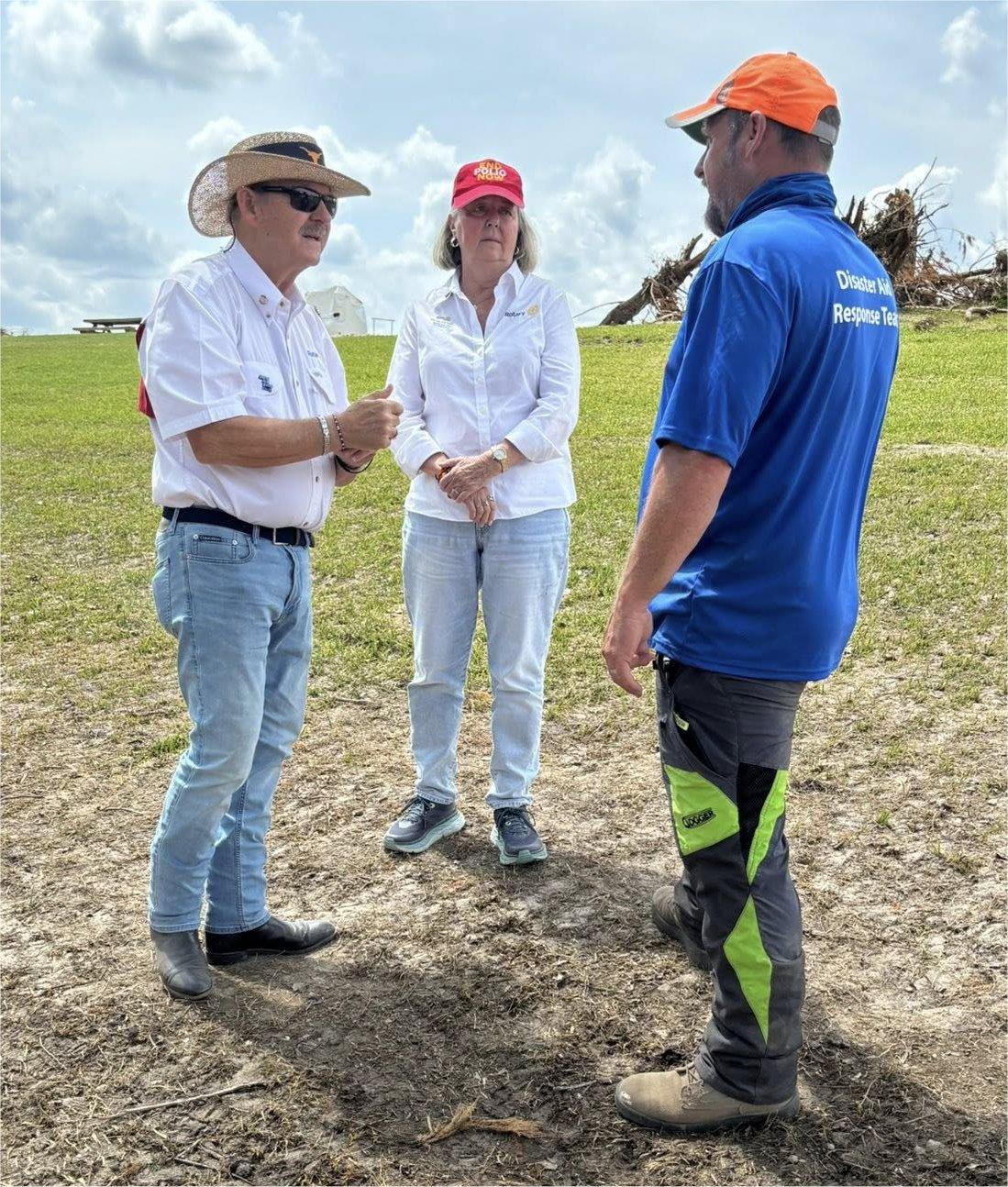
That same day, I received a call from District Governor Tom Kelchner of District 5890. He expressed his concern and introduced me to Disaster Aid USA (DAUSA). Over the next three days, we held multiple discussions about how DAUSA could support our efforts. Their extensive experience in disaster response—including the three critical phases of response, recovery, and rehabilitation—was invaluable.
After careful consideration, I determined that our district’s financial resources would be most impactful during the rehabilitation (long-term recovery) phase, though we also allocated some funds for immediate relief via local clubs.
Among those involved in our DAUSA meetings was Past District Governor Kelsey Sola from Florida. Having partnered with DAUSA during past hurricane responses, her insights were essential. She provided guidance on procedures, donation tracking, and communication strategies. She also partnered with Monica to begin the application process for a $25,000 Rotary International Disaster Relief Grant. On her recommendation, I appointed Kyle Emmons as our district’s official Disaster Relief Coordinator and primary Point of Contact.
By Monday, July 7, we began receiving reports of lives lost and missing. The full magnitude of the disaster was becoming heartbreakingly clear. I attended the Kerrville Rotary Club board meeting the next day to assure them that District 5840 was implementing a strategic plan to support both immediate response and long-term rebuilding. Also in attendance was the President of the West Kerr County Rotary Club—the area most directly affected.
I appointed Greg Faldyn to serve as the district's local Point of Contact for Kerr County. For the San Angelo area in Tom Green County, I reached out to Mason Brooks, who agreed to serve in that capacity.
On Tuesday evening, July 8, I convened a full District Leadership Team meeting to present updates and outline our comprehensive strategy. The following day, DAUSA Executive Director Larry Agee arrived in Kerr County, where he met with emergency officials and began formal assessments. His team established a base in Fredericksburg and began daily deployments to affected zones. They also introduced us to their volunteer management platform, Stability, and encouraged Rotarians to register and participate.
By Thursday, July 10, DAUSA had begun providing direct aid in Kerr County. The short-term relief phase was officially underway. Meanwhile, members of the New Braunfels Rotary Club were assisting DAUSA with search, rescue, and cleanup operations.
Donations quickly surpassed our initial expectations. Our 501(c)(3) Foundation Board met that Thursday and voted to distribute funds through local Rotary clubs—ensuring that those closest to the impacted communities could respond swiftly and effectively.
In just ten days, I witnessed the strength, unity, and compassion that define Rotary. Though we are still early in this journey, I am confident that, with the continued dedication of our members and partners, we will help restore lives and rebuild communities across District 5840.
Month-End Update
To date, we have raised over $250,000 through our District Foundation. Additionally, our application for the $25,000 Rotary International Disaster Relief Grant has been approved, and funds are expected soon. We have begun receiving and processing grant requests—primarily for replacement of critical equipment lost during rescue and response—adhering closely to Rotary International guidelines.
DAUSA remains our “boots on the ground,” supported by the tireless efforts of Rotarians from across District 5840. Hundreds of volunteer hours have been logged by Rotarians proactively stepping up—without needing to be asked. We are immensely proud of these individuals, who exemplify Service Above Self.
Rotary clubs have also hosted fundraisers and donation drives, collecting food, tools, and gear for first responders and affected families.
Through this coordinated response, we have truly Created IMPACT Through Service:
- Identified the short- and long-term challenges our communities face
- Measured the needs by defining the who, what, when, where, and why
- Planned strategically by assigning roles, setting goals, timelines, and allocating resources
- Acted by enlisting trusted partners and mobilizing community volunteers
- Communicated our shared purpose across our district and beyond
- Told the Story through social media, our website, and district-wide communications
We will continue to Unite For Good—because that is what Rotary does best.